High-Volume Screen Printing and Embroidery: What Changes at Scale
High-volume decorating is a different operation than small-batch production — different equipment, different economics, different quality controls. Here's what buyers need to understand before placing a 100,000-unit decorated apparel order.
High-volume screen printing and high-volume embroidery aren’t just bigger versions of what a local shop does. The equipment, the production management, the quality controls, and the economics are fundamentally different once you’re talking about tens or hundreds of thousands of units.
If you’re planning a large decorated apparel program, here’s what actually changes at scale — and what it means for how you spec and manage your order.
The Economics Flip at High Volume
At small quantities, setup costs dominate. Screens, separations, digitizing files, press setup time — these costs are fixed regardless of how many units you run. At 500 pieces, setup is a significant cost per unit. At 100,000 pieces, it’s less than a rounding error.
This is why high-volume decorating is dramatically cheaper per unit than small-batch work, even from the same factory:
| Order Size | Per-Unit Economics |
|---|---|
| 500 units | Setup cost is a major portion of total cost |
| 5,000 units | Setup cost is manageable but still visible |
| 50,000 units | Setup cost is negligible; production efficiency drives price |
| 100,000+ units | Maximum cost efficiency; direct manufacturer pricing justified |
The practical implication: if you’re doing high-volume decorating on a recurring basis, consolidating orders and working directly with a manufacturer — rather than through a distributor — is where significant savings live. See why direct purchasing matters at 100,000+ units.
High-Volume Screen Printing: How It Works
Equipment Built for Volume
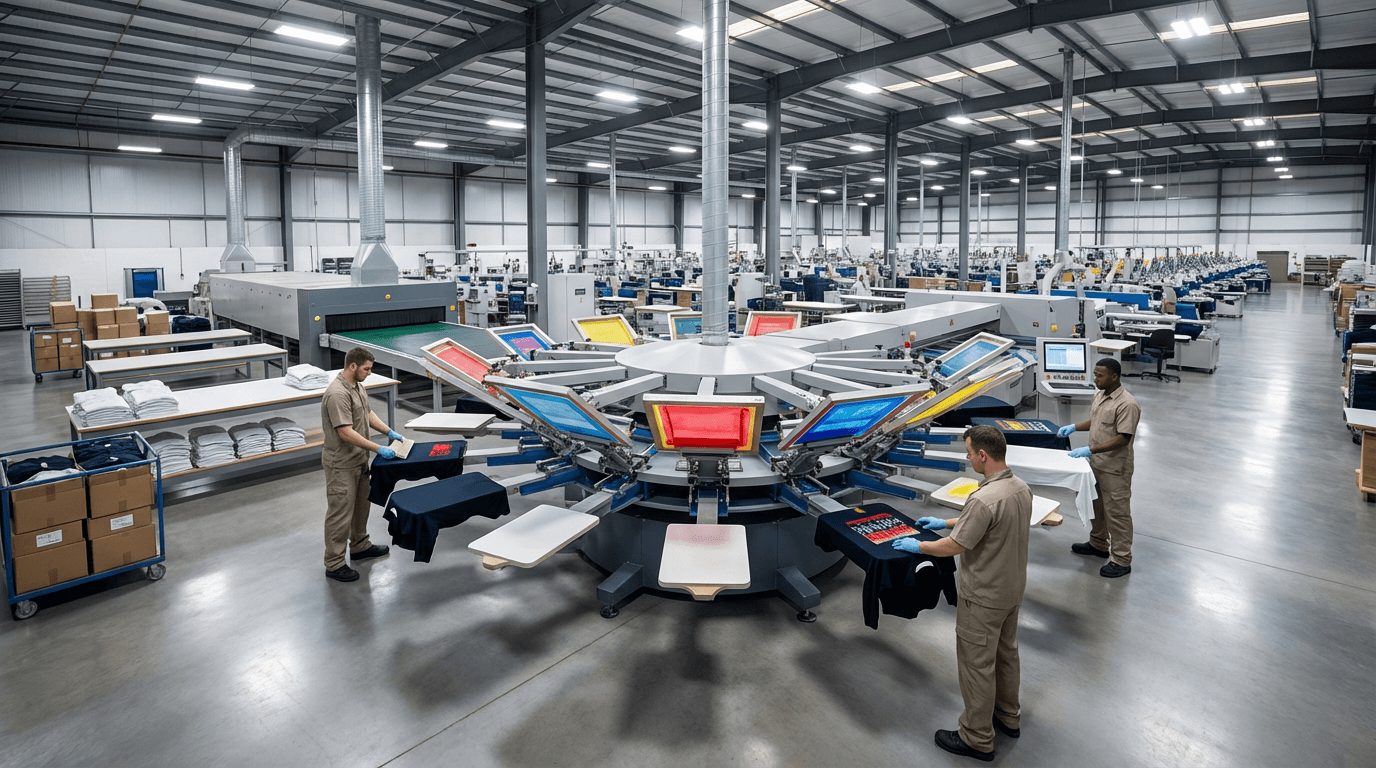
High-volume screen printing runs on automatic oval or carousel presses — machines with 8 to 14 print heads that rotate garments through each color station automatically. Manufacturers like ROQ build the industrial presses that serious high-volume decorators run. A well-run automatic press can output thousands of decorated pieces per hour.
This is categorically different from a manual press, where a human operator physically pulls the squeegee on every print. Manual presses are appropriate for short runs and specialty work. For high-volume screen printing, automatic presses are the only practical option.
Color Consistency Across the Run
At 100,000 units, color must be consistent from the first piece to the last. This requires:
- Pantone-matched ink mixing — Inks mixed to a Pantone PMS specification using a spectrophotometer, not eyeballed. See Pantone matching for brand consistency.
- Ink weight controls — The amount of ink deposited per print must stay consistent as ink levels, temperature, and squeegee pressure fluctuate over a long run.
- Mid-run QC pulls — Production staff pulling samples at intervals to catch drift before it compounds across thousands of units.
Ink Selection at Scale
High-volume screen printing runs primarily on plastisol ink — the industry standard for durability, opacity, and wash fastness on large runs. Water-based and discharge inks are used for retail and fashion programs where soft hand feel is required, but they demand tighter process controls.
If your program involves performance fabrics (polyester, moisture-wicking materials), ink selection gets more technical. Dye migration — where polyester dyes bleed into the ink during curing — is a production risk that requires specific ink formulations and curing protocols. See decorating athletic and performance fabrics at scale and plastisol vs. water-based ink for large orders.
High-Volume Embroidery: How It Works
Multi-Head Machine Banks
High-volume embroidery runs on commercial multi-head machines — each machine has multiple embroidery heads stitching simultaneously. A 12-head machine produces 12 identical pieces in the time it takes a single-head machine to produce one.
At 100,000 units, the facility needs dozens of these machines running continuously, with production management that keeps all of them running at capacity and maintains consistent output across the run.
Digitizing for Production, Not Proofing
Digitizing — converting artwork into a machine-readable stitch file — is the most important upstream variable in embroidery quality. A file optimized for a one-off proof looks different from a file optimized for 100,000 units of consistent production.
Production digitizing accounts for:
- Stitch density calibrated for the specific fabric (heavier backing on stretch materials, lighter on stable wovens)
- Underlay sequences that anchor the design without adding unnecessary stitch count
- Pull compensation for stretch in the final design dimensions
In-house digitizing, done by someone who understands the production machines, is a meaningful differentiator between high-volume embroidery manufacturers and shops that digitize as an afterthought.
Stitch Count and Cost
High-volume embroidery is priced primarily by stitch count. A 5,000-stitch left-chest logo and a 20,000-stitch full-back design are very different production commitments — and very different costs at 100,000 units. Before committing to artwork, understand what the stitch count will be. See embroidery stitch count explained.
High-Volume Decorating Programs That Use Both Methods
Most large decorated apparel programs use both screen printing and embroidery, applied to different garment types within the same program.
Screen printing is the right choice for:
- T-shirts and casual apparel
- Event merchandise
- Bags and accessories
- Any item where cost-per-unit is the primary constraint
Embroidery is the right choice for:
- Polos and dress shirts
- Structured headwear (caps, beanies)
- Fleece and outerwear
- Any item where the decoration needs to communicate quality
A corporate uniform program, a franchise system, or a large retail private label line will typically need both. Working with a single high-volume decorating manufacturer who handles both in-house eliminates vendor coordination and keeps quality standards consistent across the program.
See screen printing vs. embroidery for large orders for a detailed comparison.
What to Verify Before Placing a High-Volume Order
Production capacity. Ask specifically: what is your weekly throughput for a run of this size? A manufacturer who regularly runs high-volume screen printing or embroidery can answer this precisely. A distributor or small shop will give a vague answer.
Pre-production sample. Always get a production sample — a piece run on actual production equipment, not a handmade proof — before committing to full run. This is standard practice for high-volume decorating. If a vendor pushes back on it, that’s a signal.
QC process. How are mid-run checks done? What triggers a press stop? What happens to out-of-spec units? These questions reveal whether a manufacturer has a real quality system or just catches problems when customers complain.
Lead time commitments. High-volume decorating has real capacity constraints. Get the production schedule in writing — start date, production completion, ship date — and confirm it’s based on actual press availability, not an optimistic sales number.
For a full framework, see how to evaluate a screen printer before a large order.
Merch Factory Direct runs high-volume screen printing and embroidery programs for orders of 100,000+ units. US-based production, in-house pre-press and digitizing, factory-direct pricing. See our screen printing and embroidery capabilities, or contact us to get a quote.