How to Evaluate a Screen Printer Before Placing a 100,000+ Unit Order
Placing a six- or seven-figure screen print order with a manufacturer you haven't worked with is a real risk. Here's a practical framework for vetting a screen printer before you commit — what to ask, what to look for, and what disqualifies a vendor.
At 100,000+ units, a production failure is not a nuisance — it’s a business crisis. An event with 80,000 shirts that arrives in the wrong color, or a uniform program with inconsistent embroidery across 50,000 pieces, doesn’t have a simple fix. The cost of a bad vendor at large volume is exponentially higher than the cost of proper vetting before the order.
Here’s how to evaluate a screen printer before placing a large order.
Start with Capacity, Not Samples
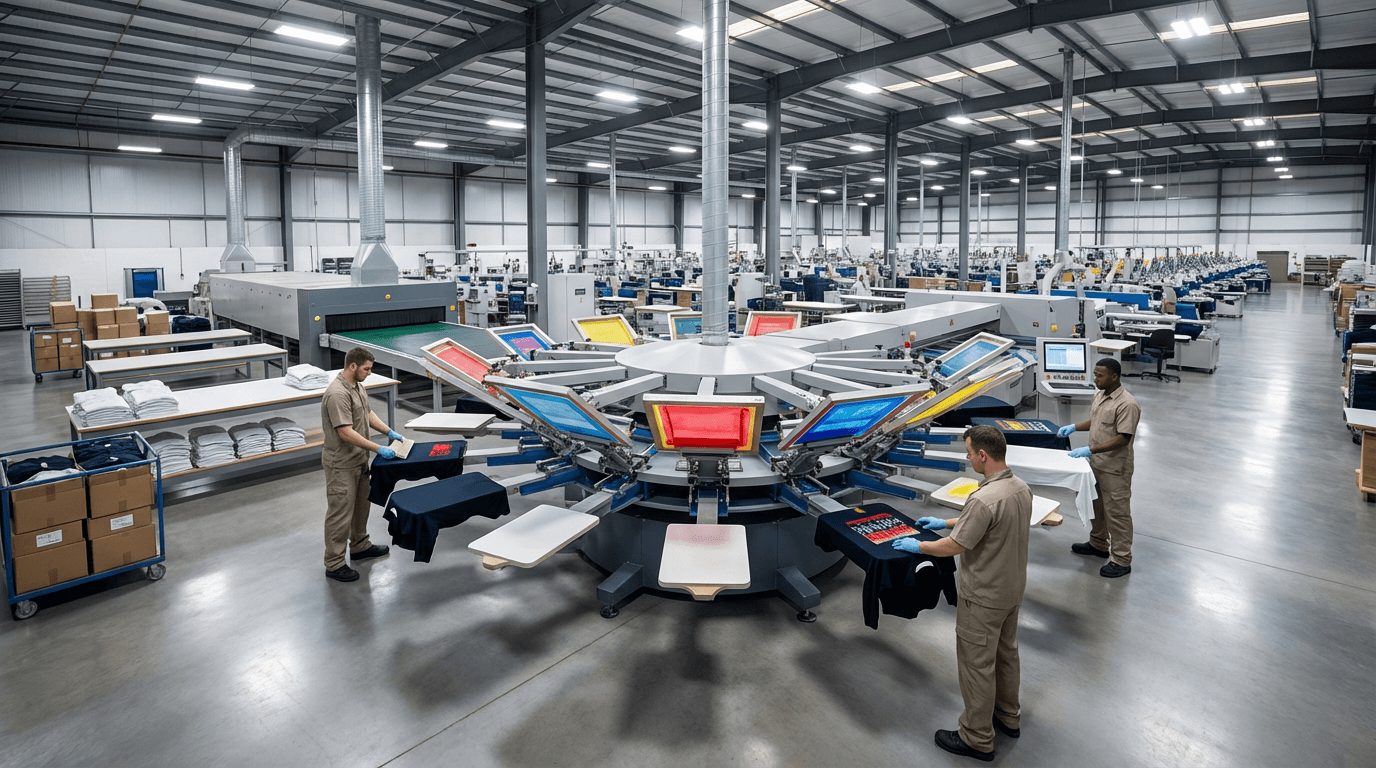
The first question to answer isn’t “can they print well” — it’s “can they print this volume.” Many shops that produce excellent work at 5,000–10,000 units don’t have the infrastructure to handle 100,000+ units within a reasonable timeline.
Questions to ask about capacity:
- How many automatic presses do you run, and what are their maximum colors?
- What’s your average monthly output in decorated pieces?
- What’s the largest single order you’ve completed in the past 12 months?
- What’s your current production queue, and what lead time would apply to an order of this size?
A shop running 3–4 automatic presses with a 300,000 piece/month capacity is a credible partner for a 100,000-unit order. A shop that has never run an order above 20,000 units is not the right partner for your program, regardless of sample quality.
Verify Financial Stability
A screen printer who takes a $400,000 purchase order and can’t pay for blanks, ink, or labor without your deposit cash is a production risk. Financial distress at a supplier creates pressure to cut corners, delay production, or in extreme cases, fail to deliver entirely.
This isn’t about being suspicious — it’s about protecting a significant commitment.
Signals to look for:
- Do they require an unusually large upfront deposit (more than 50%)? A financially healthy manufacturer typically takes 30–50% down, balance on delivery.
- Can they provide credit references or a D&B report on request?
- How long have they been in business, and is there any public record of financial distress, judgments, or ownership changes?
- Do they own their facility and major equipment, or are they leasing under conditions that could disrupt production?
Review Production Samples — But the Right Ones
Samples are necessary, but asking to see “samples of your best work” doesn’t tell you much. Anyone can show their best work.
More useful sample requests:
- Ask for a sample from a comparable order: Specifically from an order close to your volume, using the garment type and print method you’re planning. Quality at 100 pieces and quality at 100,000 pieces aren’t the same thing.
- Ask for samples from the middle and end of a large run, not just the first piece: Color drift, print registration, and ink coverage often degrade over a long run if process controls aren’t in place. A pre-production strike-off looks perfect; the 95,000th piece off a poorly managed press may not.
- Ask about seconds and defect rates: A reputable shop can tell you their defect rate and how they handle defects — culling from the run, reprinting, offering credit. A shop that claims to have near-zero defects is probably not measuring carefully.
Understand Their Art and Pre-Press Process
Production problems in screen printing often originate in pre-press — the step where your artwork is prepared, films are burned, and screens are made. A shop with a sloppy pre-press process will produce unpredictable results at scale. (See our artwork preparation guide for what production-ready files look like, and our Pantone matching guide for color specification requirements.)
Questions to ask:
- Do you review customer-provided artwork for production readiness before confirming the order?
- How are films produced — direct-to-screen, imagesetter, or hand-cut? (Direct-to-screen is the modern standard for accuracy.)
- How many lines per inch do your screens print at, and what’s your maximum print resolution?
- How do you confirm color matches before a full run starts? Do you produce a physical strike-off on the actual garment?
- How do you maintain color consistency across a long run — how often do ink mixes get checked?
Tour the Facility If Possible
No questionnaire replaces a facility visit for a large order. A 2–3 hour plant tour will tell you more than weeks of email exchanges.
What to look for during a tour:
Organization and cleanliness: A facility that’s clean, organized, and systematically laid out signals process discipline. A chaotic floor with ink stains, unlabeled supplies, and no clear workflow signals risk.
Equipment condition: Are the presses well-maintained? Do they see calibration logs or maintenance records? Older equipment isn’t disqualifying, but poorly maintained equipment is.
In-process quality checks: Do you see operators pulling pieces off the press and checking registration, color, and cure? Are there QC stations visible in the production flow? Or do pieces just move from press to dryer to box without inspection?
Blanks receiving and storage: How are garments received and stored before decoration? Are they organized by style, color, and size? Are they protected from contamination? Receiving errors and picking errors in the blanks are a significant source of large-order problems.
Workforce stability: Ask about average employee tenure. High turnover in a print shop produces inconsistent quality. Long-tenured operators know their presses and can catch problems intuitively.
Ask for References — and Actually Call Them
A vendor who hesitates to provide references for comparable orders is a red flag. A vendor who provides names but where the references are hard to reach or give vague answers is a softer red flag.
When you call references, ask specific questions:
- What was the order size and product type?
- Were quantities delivered on time? If not, what happened and how was it handled?
- Were there quality issues? If so, how were they resolved?
- Would you place another order with them?
- Was the final product quality consistent with the pre-production sample?
What Disqualifies a Vendor
Some findings are disqualifying regardless of price or other factors:
- Unable to provide comparable references: If they can’t point to orders of similar size that went well, don’t assume yours will be the first.
- Vague answers on capacity and lead time: “We can handle anything” is not a capacity answer. Get specifics.
- No pre-production approval process: Any serious shop produces and obtains approval on a pre-production strike-off before running a large order. A shop that wants to run straight from digital approval without a physical sample is cutting a step that protects both parties.
- Pressure to skip contract terms or bypass standard procurement steps: Standard contracts, purchase orders, and terms exist for good reasons. A vendor uncomfortable with written terms is uncomfortable with accountability.
- Price significantly below market: At large volume, below-market pricing usually means something is being cut. Garment quality, ink quality, QC labor, production throughput — something absorbs the cost. Understand what before accepting a price that seems too good. See how promo distributors mark up screen printing for context on what factory-direct pricing should look like, and screen print setup fees explained for what a legitimate cost structure includes.
The Pre-Production Sample Is the Final Test
After all the vetting, before the full run starts, the pre-production sample is the definitive test. This is a physical piece — or a small run of pieces — produced on your actual garment with your actual artwork and ink, approved by your team before production begins.
Do not waive the pre-production sample on a large order, regardless of time pressure. The cost of waiting 3–5 days for a sample is trivial compared to the cost of discovering a color match or registration problem at piece 90,000.
Merch Factory Direct invites prospective buyers to tour our production facility and provides pre-production samples on all large orders. Review our production process and why large buyers go direct to understand how we operate. For a look at how our pricing compares to distributor channels, see how promotional companies mark up screen printing. Contact us to start a conversation — and review our minimum order requirements.