Plastisol vs. Water-Based Ink: Which Is Right for Your Large-Volume Screen Print Order?
The ink type you choose for a large screen print run affects cost, durability, hand feel, and compliance requirements. Here’s how plastisol and water-based inks compare for buyers at 100,000+ units.
For a 100,000-unit screen print order, the ink you choose is not a minor detail. It affects cost per unit, how the finished garment feels, how it holds up through washing, and whether it qualifies for retail compliance programs. Most buyers default to whatever their vendor recommends. Buyers at this scale should understand the decision themselves.
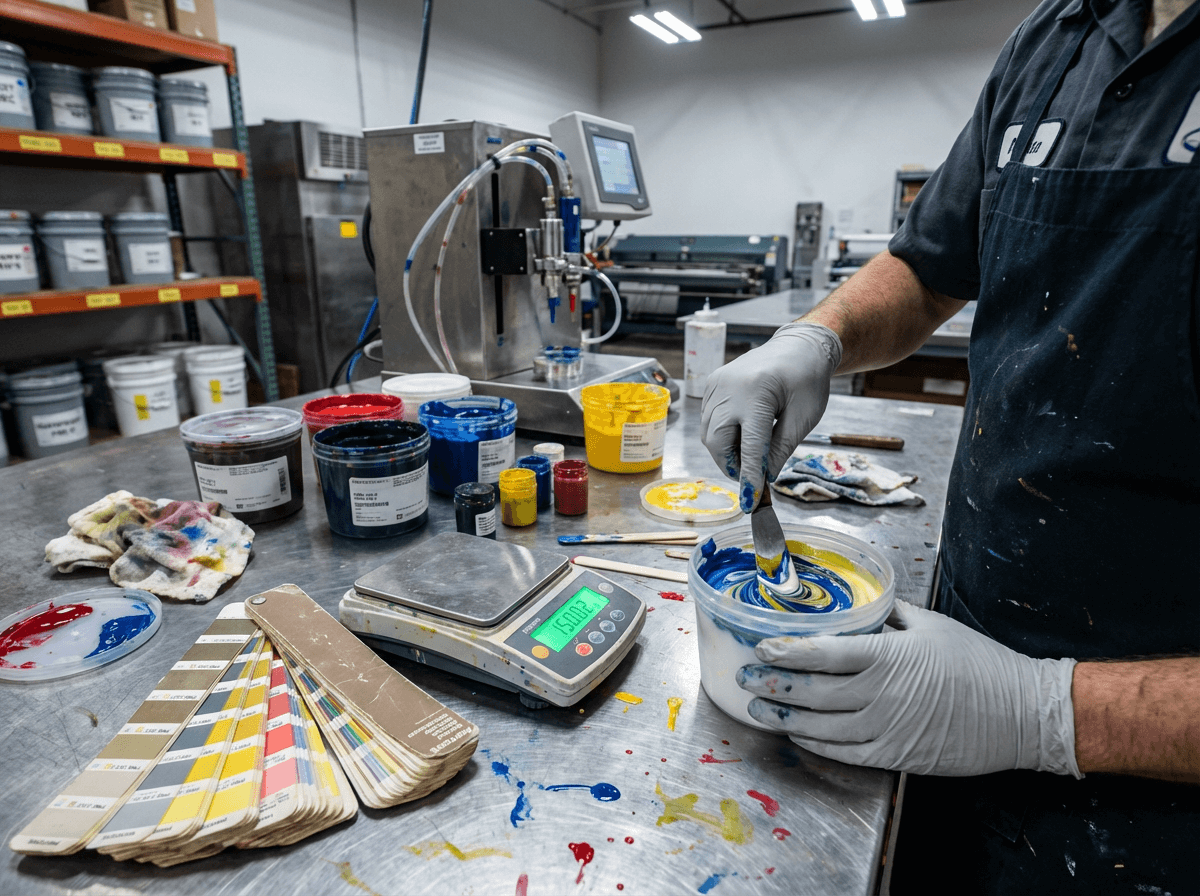
What Plastisol Ink Is
Plastisol is a PVC-based ink suspended in a plasticizer. It is the industry default for screen printing, and for good reason: it is stable, consistent, and forgiving in production. Plastisol does not dry on the screen between prints, which means it can sit on press during downtime without hardening. It cures at a specific temperature, typically around 320 degrees F, and produces a bright, opaque print with excellent color consistency across long runs.
The result on the garment is a slightly raised, tactile surface. On a heavy cotton tee, this is barely noticeable. On a lightweight or fashion-blend fabric, the ink sits more visibly on top of the surface.
What Water-Based Ink Is
Water-based ink uses water as the primary carrier, with pigments suspended in an emulsion. It penetrates the fabric fibers rather than sitting on top of them. The result is a softer hand feel, often described as printing with the fabric rather than on it, and a print that breathes with the garment.
Water-based inks require more careful management on press. They can dry in the screen if left too long, which increases press downtime and waste on high-volume runs. They require precise dwell times and higher cure temperatures. These factors add production complexity that experienced printers manage routinely, but they are real constraints.
Discharge ink is a variant of water-based printing that removes the dye from the fabric and replaces it with pigment. The result is an extremely soft print that appears to be part of the fabric itself. Discharge only works on 100% cotton garments dyed with compatible reactive dyes.
Side-by-Side Comparison
| Factor | Plastisol | Water-Based |
|---|---|---|
| Cost per unit | Lower | Slightly higher |
| Hand feel | Slightly raised, firm | Soft, fabric-integrated |
| Cure requirements | Straightforward | More precise, higher temp |
| Color vibrancy | Excellent, highly opaque | Good; less opaque on dark fabrics |
| Wash durability | Excellent | Excellent when properly cured |
| Oeko-Tex / retail compliance | Requires PVC-free formulation | Easier to certify |
| Dark fabric performance | Excellent (requires underbase) | Discharge preferred |
| Light fabric performance | Excellent | Excellent |
| Fabric compatibility | Cotton, poly, blends | Best on 100% cotton; some blends |
| On-press stability | High | Lower; active management required |
Compliance and Certification
This is where water-based ink has a clear advantage for certain buyers. Standard plastisol ink contains PVC and phthalates, which are restricted under several compliance frameworks. Many major retailers, and particularly European and California markets, require or strongly prefer PVC-free and phthalate-free decoration.
Water-based inks are inherently better positioned for Oeko-Tex Standard 100, bluesign, and similar certifications. If your end use includes retail placement, uniform programs subject to regulatory requirements, or export to EU markets, the compliance question may determine your ink choice before cost or aesthetics enter the calculation.
PVC-free plastisol formulations exist and are increasingly common, but they require your manufacturer to stock and run them intentionally. Verify this before assuming.
Cost at Large Volume
The per-unit cost difference between plastisol and water-based is real, though smaller than many buyers expect. The differential comes primarily from ink cost and production overhead. Water-based inks cost more per pound and require more careful press management.
At 100,000 units with a two-color print, the difference might be $0.05 to $0.15 per unit depending on the ink system and manufacturer. That translates to $5,000 to $15,000 on a 100,000-unit run. Not trivial, but not the dominant cost factor. At 500,000 units the math scales proportionally, and the decision deserves more deliberate attention.
Specialty Inks
Beyond plastisol and water-based, several specialty systems are worth knowing at large volume.
Puff ink contains a heat-activated foaming agent that creates a raised, three-dimensional effect. It adds a premium look to simple designs and costs modestly more than standard plastisol.
Metallic ink contains aluminum particles for a shimmery finish. It works well for accent colors and secondary elements, though full-coverage metallics can produce a stiffer hand feel.
High-density (HD) ink uses a specialized screen to build up thick, raised print elements, closer to an embossed look. Production is slower and cost is higher. Best used as a design accent rather than a full-print system.
Specialty inks can be combined with standard plastisol or water-based systems. At large volume, they add cost and complexity but can meaningfully differentiate a finished product.
When to Choose Each
Choose plastisol when:
- Cost per unit is the primary constraint
- Fabric includes polyester or synthetic blends
- You need maximum color opacity and vibrancy on dark garments
- Compliance requirements are standard or PVC-free plastisol is specified
Choose water-based or discharge when:
- Soft hand feel is a priority (fashion, retail, premium programs)
- 100% cotton garments are being decorated, especially for discharge
- Retail compliance, Oeko-Tex, or EU market requirements apply
- Brand positioning calls for a more natural, sustainable presentation
The ink choice at 100,000+ units is worth making deliberately, not by default. The difference in total cost, compliance posture, and finished product quality is real, and at this volume it compounds.
Merch Factory Direct is a US-based screen print and embroidery manufacturer for orders of 100,000+ units. Learn more about our screen printing capabilities, or request a direct quote.