Screen Printing 100,000 Shirts: What the Production Process Actually Looks Like
Most buyers have never watched 100,000 shirts get screen printed or 100k units get embroidered. Here's what producing apparel at scale actually involves — from pre-press to finished goods.
Placing a 100,000-unit order is different from placing a 1,000-unit order in every meaningful way. The equipment is different, the process is different, the timeline is different, and the economics are different. Here’s what the production process actually looks like when you’re screen printing 100,000 shirts — or running a comparable bulk embroidery order.
Before Production Starts: Pre-Press and Setup
No press runs without pre-press. For screen printing at scale, pre-press includes:
Artwork and color separation. Your design is separated into individual color layers — one film positive per ink color. A two-color print requires two separations; a six-color print requires six. Each separation becomes a screen.
Screen coating and exposure. Each screen is coated with photosensitive emulsion, exposed to UV light through the film positive, and developed to create the stencil. At 100,000 units, screens are made to last the full run. A screen that breaks down at 50,000 impressions requires a mid-run replacement and risks a registration shift.
Ink mixing. Inks are mixed to Pantone PMS spec using a spectrophotometer. The formula is recorded so the same color can be reproduced on reorder runs. See Pantone matching for brand consistency.
Press setup. Screens are mounted on the press, registered to each other, and tested on production garments. The first pieces off the press are checked against the approved spec before full production begins.
This pre-press work takes place before a single production shirt is printed. Setup cost is fixed regardless of quantity — which is why per-unit cost drops sharply at high volumes. At 100,000 units, pre-press is effectively a rounding error.
For the equivalent on an embroidery order: artwork is digitized (converted to a machine-readable stitch file), hooping frames are set up, and thread colors are loaded and matched. See embroidery stitch count explained.
Production: How 100,000 Shirts Actually Get Printed
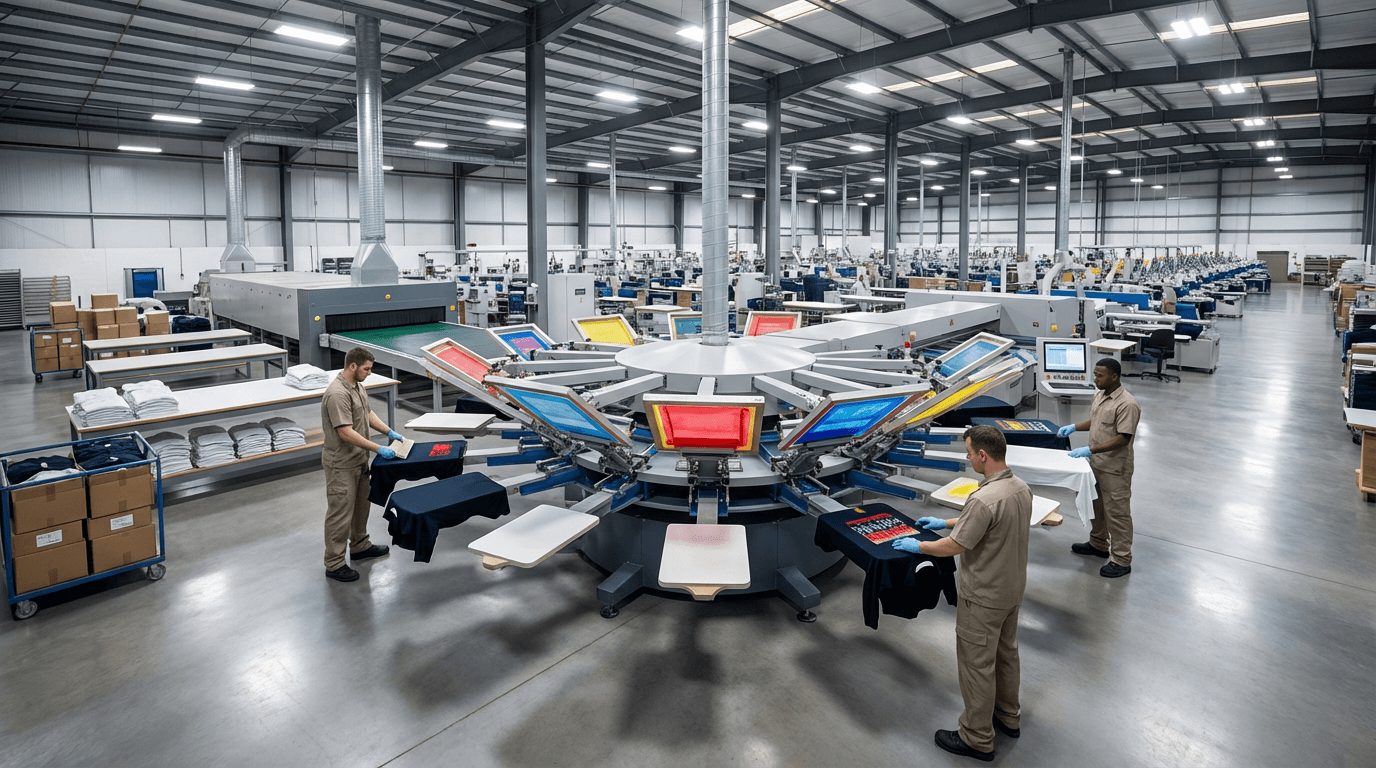
High-volume screen printing runs on automatic oval or carousel presses — machines like those made by ROQ — with 8 to 14 print heads arranged around a rotating carousel. Garments are loaded onto pallets, rotate through each color station where the screen lays down one ink color, and exit through a conveyor dryer that cures the ink.
A single well-run automatic press can output several hundred to over a thousand decorated pieces per hour, depending on color count, design size, and garment type. At that throughput, 100,000 units of a simple design takes 2–4 days of dedicated press time. Complex multi-color designs take longer.
What happens during a long production run:
- Ink viscosity management. Ink behaves differently as temperature and humidity change over a shift. Press operators monitor ink weight and adjust squeegee pressure and speed to maintain consistent deposit.
- Registration checks. On multi-color designs, screens must hit the same position on every garment. Operators pull pieces periodically to verify registration hasn’t drifted.
- Color pulls. QC staff compare production pieces against the approved pre-production sample at regular intervals — typically every few hundred pieces. Drift gets caught before it compounds.
- Defect sorting. Misregistered or under-cured pieces are pulled and set aside. Overage production (running extra units above the order quantity) accounts for expected yield loss.
For bulk embroidery at 100k units, the production model is similar: banks of multi-head embroidery machines running simultaneously, each head stitching an identical piece. A 12-head machine produces 12 pieces per cycle. Dozens of machines running in parallel make 100,000 units achievable on a reasonable timeline.
How to Produce Apparel at Scale: The Timeline
A realistic production timeline for a 100,000-unit screen print or bulk embroidery order:
| Phase | What Happens | Typical Duration |
|---|---|---|
| Quote and approval | PO issued, specs confirmed, artwork submitted | 3–5 days |
| Pre-production sample | Press strike-off or embroidery sample on actual production equipment | 5–10 days |
| Sample approval | Buyer reviews and approves (or requests revision) | 2–5 days |
| Blank procurement | Garments ordered and received at decorator | 7–14 days |
| Production | Full run completed | 7–21 days |
| QC and finishing | Final inspection, folding, packing | 3–7 days |
| Shipping | Ground freight or LTL depending on destination | 3–7 days |
Total realistic timeline: 6–10 weeks from PO to delivery.
Buyers who try to compress this — skipping the pre-production sample, requesting blank garments they don’t have in stock, or booking production that’s already at capacity — compress the timeline but not the risk. See the cost of a rushed screen print order.
What Makes Mass Production Apparel Decoration Different from Small Batches
The difference is not just quantity. The entire operation is structured differently:
Equipment: Automatic presses and multi-head embroidery machines are built for continuous production. A manual press that a small shop uses for 500-unit runs cannot produce 100,000 units with competitive economics or color consistency.
Capacity planning: At 100,000 units, a manufacturer needs to schedule your job into their production calendar — press availability, blank receiving, pre-press lead time. You’re not slipping in between other jobs. You’re booking a production window.
Quality controls: Large order garment decoration requires systematic QC, not spot checks. The difference between 97% and 99.5% on-spec output is 3,000 vs. 500 defective units in a 100,000-unit run. Serious manufacturers have documented QC processes, not just “we check quality.”
Direct relationship: At 100,000 units, you should know who is actually running your production — not just a sales rep at a distributor. The manufacturer knows your spec, your brand standards, and your timeline. The distributor just knows your PO number.
See why direct purchasing matters at scale and how to evaluate a screen printer before a large order.
What to Have Ready Before You Order
Before contacting a mass production apparel printing factory or contract decorator:
- Finalized artwork in vector format (AI or EPS), with exact Pantone colors specified
- Confirmed garment selection — style, brand, colors, and size curve. See size curve management for large apparel orders.
- Decoration specifications — print location(s), size, color count; or for embroidery, placement and approximate stitch count
- Quantity by style and size — exact breakdown, not approximate totals
- In-hands date — the date you need finished goods delivered
The more complete your spec, the faster and more accurate your quote — and the smoother your production run.
Merch Factory Direct produces large-scale screen printing and bulk embroidery orders for buyers at 100,000+ units. US-based production, ROQ automatic press lines, in-house digitizing, factory-direct pricing. See our screen printing and embroidery capabilities, or contact us to discuss your order.