Size Curve Management for Large Apparel Orders: Getting the Mix Right
Ordering 100,000 units is only half the problem — getting the size distribution right is the other half. Here's how experienced buyers plan size curves, avoid leftover inventory, and handle size corrections before production starts.
One of the most overlooked sources of waste in large decorated apparel programs is the size curve — the breakdown of how many units you order in each size. Get it wrong and you end up with 12,000 XL shirts you can’t move and a shortage of 2XL that frustrates your end recipients. At 100,000 units, a 12% error in size distribution is $36,000 worth of the wrong shirts.
Size curve planning is not complicated, but it requires deliberate attention. Here’s how to do it correctly.
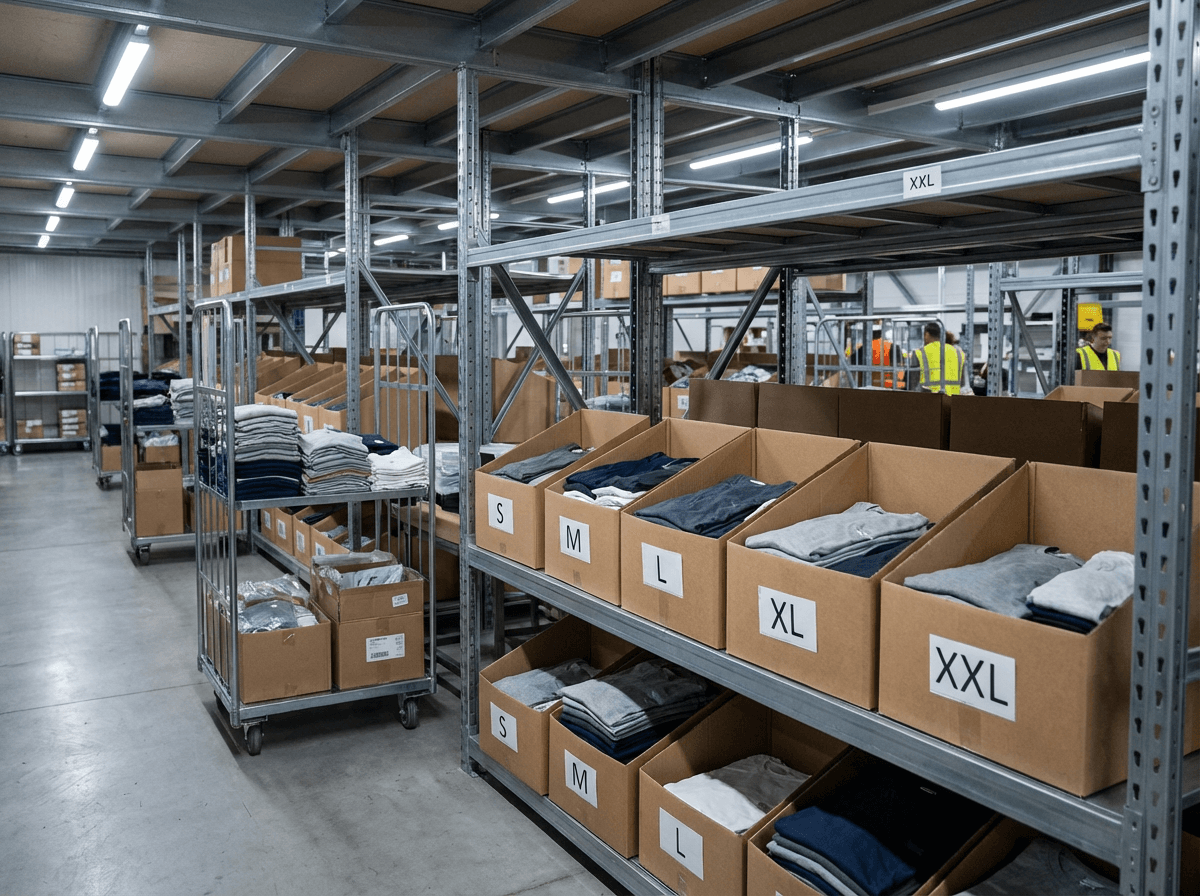
What a Size Curve Is
A size curve is simply the percentage or unit breakdown of your total order across each size. For a 100,000-unit shirt order, a size curve might look like:
| Size | % | Units |
|---|---|---|
| S | 8% | 8,000 |
| M | 20% | 20,000 |
| L | 26% | 26,000 |
| XL | 24% | 24,000 |
| 2XL | 14% | 14,000 |
| 3XL | 6% | 6,000 |
| 4XL | 2% | 2,000 |
| Total | 100% | 100,000 |
The right curve for your order depends entirely on who is receiving the product and what the historical data shows.
Why Generic “Standard” Curves Are Usually Wrong
Many buyers — especially first-time large-order buyers — ask their manufacturer for a “standard” or “typical” size curve. Manufacturers will often provide one based on industry averages, which is better than nothing but is almost never right for a specific population.
The problem is that size distributions vary significantly by:
Industry and workforce: A construction company’s workforce skews heavily toward larger sizes. A healthcare employer with a predominantly female staff may skew toward smaller sizes. A tech company may be more evenly distributed but lean smaller overall.
Geography: Average apparel sizes vary by region and country. A national program needs a different curve than a regional one.
Product type: Sizing conventions differ across product categories. A fitted women’s style requires a very different curve than a unisex tee. Performance styles often run smaller than equivalent cotton styles.
Price and gifting context: When apparel is purchased vs. gifted as a benefit or incentive, the size distribution shifts — people who self-select tend to know their size; gifted sizes often require a buffer in the median sizes.
How to Build an Accurate Size Curve
1. Use your own data when you have it.
If you’ve run this program before, pull the size distribution from your last order or two. Actual redemption data is far more accurate than any industry estimate. If you consistently run short on 2XL and long on S, adjust the curve — don’t reorder against the same flawed split.
2. Survey your recipients before ordering.
For corporate uniform programs, employee programs, or any program where recipients are identifiable in advance, a simple size survey eliminates most guesswork. A two-question survey (size and cut preference, if applicable) takes less than a minute to complete and can be collected via email or an HR system. The savings on not overproducing wrong sizes far exceed the effort.
3. Build in extra on the middle and add-on sizes.
If you can’t collect data, the general principle is to weight toward L and XL (the statistical median for most adult US populations) and carry meaningful stock in 2XL. Shortfalls in 2XL and 3XL are more disruptive than overruns because extended sizes are harder to source on short notice and represent recipients who are underserved by programs that guess conservatively.
4. Build a small unallocated reserve.
For programs where individual recipients will request their sizes over time, building a 3–5% unallocated reserve in the most common sizes (usually L, XL, 2XL) provides a buffer for replacements, new hires, size exchanges, and errors. Reserve inventory ordered upfront costs far less than a separate reorder at low quantity.
The Reorder Problem
Reorders to correct size curve errors are expensive. The economics of screen printing favor volume: at 100,000 units, your decoration cost per piece is optimized. A follow-up reorder of 2,000 pieces in 2XL to cover a shortage will cost dramatically more per unit — potentially 3–5x the per-unit cost of the original run, plus setup charges, plus freight.
The lesson: it’s almost always cheaper to overbuild slightly on the sizes most likely to run short than to fix a shortage with a separate reorder.
Women’s Sizes and Cut Considerations
Large programs that include women’s styles add a layer of complexity. Women’s fitted sizes don’t correspond to men’s or unisex sizing in a predictable way. A woman who wears a men’s L tee may wear a women’s XL or 2XL depending on the cut.
If your program includes both unisex and women’s styles, the size curves for each should be built independently. Don’t simply apply a gender ratio to a single curve.
For programs where recipients choose their own style and size, a clear sizing chart — with measurements, not just S/M/L designations — is essential at the point of collection.
Communicating the Curve to Your Manufacturer
Once your size curve is determined, provide it to your manufacturer in explicit unit counts, not just percentages. “26% in L” leaves room for rounding interpretation at 100,000 units. “26,000 units in L” does not.
Also confirm how your manufacturer handles production variance. Most will produce within +/- 2–5% of ordered quantities. Understand how that variance is allocated across sizes — whether by size in proportion to the order, or based on production yield — and confirm that oversized sizes aren’t compensated with the wrong sizes.
Merch Factory Direct works with buyers to plan accurate size curves for 100,000+ unit programs and maintains size-level reporting throughout production. For a related discussion on garment selection, see our blank garment sourcing guide. For how size curves fit into a broader program structure, see corporate branded apparel program structure or franchise apparel programs. Contact us to discuss your program — and see our minimum order requirements.